

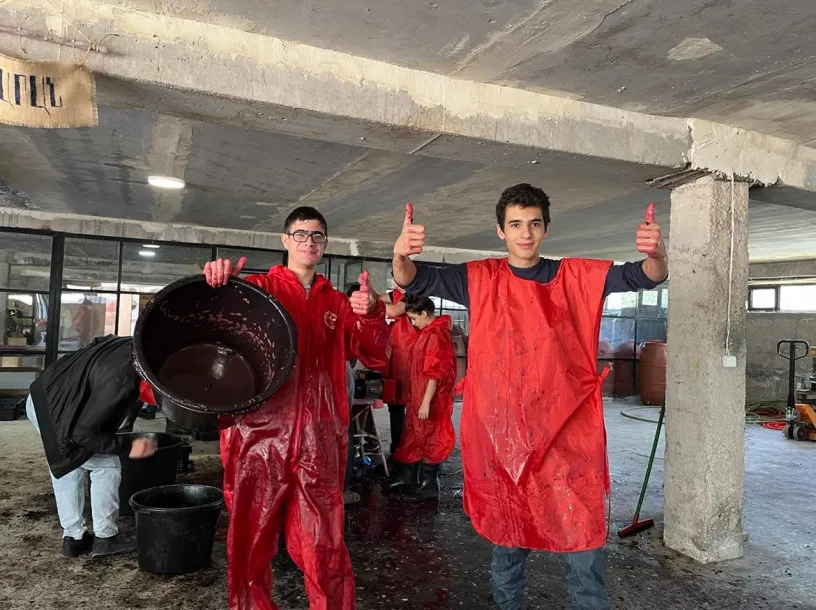
Winemaking at the Mkhitar Sebastatsi Educational Complex is a profession that combines science, production, culture, and creativity. That is why education here cannot be limited to transferring theoretical knowledge and performing practical tasks. From the very beginning, an educational model has been formed here that leads the student to a real professional environment, forming not only knowledge, but also experience. This model is a production-based learning model, in which the “Winemaking” specialty is taught in real production conditions, perceived as a learning environment. This is a unique educational project in Armenia, the key idea of which is to entrust the student with real professional activity. The principle of trust is as follows: the students’ strengths are assessed, and then, by developing them, they are involved in relevant work, forming responsible, teaching, initiative and controlling individuals.
Author’s model of winemaking teaching: training in a production environment
Winemaking, being a modern and cultural profession, requires an unconventional approach: it is an education that is simultaneously knowledge, action, practical experience, a means of forming responsibility, creativity, and team awareness. We cannot limit ourselves to theoretical and bookish materials when hand work, memory of smell and taste, and the courage to make mistakes and learn from them are required. Real education begins the moment a student stands before a vine or wine, fully responsible for every decision he makes. Here the student is a fully thinking, responsible, and creative participant.
A unique educational model, “production in the learning environment,” is implemented at the Mkhitar Sebastatsi Educational Complex College, where students fully participate in the entire wine creation process. The teaching methodology is based on the idea that the student does not learn winemaking, but becomes a winemaker, overcoming difficulties during the production stages, solving unforeseen problems, establishing a connection between raw materials, technology and the result, realizing the consequence of each step. The educational process is simultaneously built in an open professional environment, where students interact and collaborate with experienced winemakers, technologists and industry professionals, participate in meetings, tastings and discussions. These connections are not limited to one course or visit; they are continuous and contribute to the formation of professional thinking, the transfer of experience and a more conscious choice of future profession.
Training during real production
The methodology of organizing the courses is based on real wine production: from grape harvesting to bottling and selling. Students responsibly participate in all stages: raw material selection, vineyard work, harvesting, crushing, fermentation, control, technological decision-making, pressing, stabilization, filtration, bottling, presentation, sales.
This kind of activity is not a common practice; it is a year-round production that requires responsibility, where every wrong and right decision or any delay has its consequences. Each student sees that a real product, real wine, is formed in their hands. This responsibility shapes professional mature thinking, where understanding the process, time management, and teamwork are important. Only in a production environment does the student find himself in a real professional role, learning to anticipate risks, orient himself, and express himself. This educational model allows making the educational process visible and tangible, an activity that creates real value.
The teacher is a companion/friend, not just a knowledge transmitter.
There is no single person who knows the truth in teaching approaches. The teacher works as a discussion participant, guide, experience transmitter, researcher, and often as a learner. Lessons are built through dialogue, questions, experiments, and discussions. Making mistakes is an accepted process, as professional logical thinking is formed through mistakes. As a result of this approach, the student learns not to be afraid to ask questions, to disagree with accepted opinions, and to formulate their own justifications. The learning environment is a space where knowledge is formed through collaboration, observation, and experience. This is how an independently thinking and collaborating professional is formed.
Creativity and interdisciplinary connections
This teaching method involves not only the use of technology, but also culture, history, a social program (a phenomenon that connects people to each other and to us through wine), marketing, and style. Students are involved in research work, new projects and programs, work on ideas for creating labels, discuss issues of wine presentation and sales, which contributes to the formation of a comprehensively developed specialist; all this is done through cooperation with other specialties of the College.
Modernity and Armenian identity
The training combines modern approaches and traditional Armenian winemaking methods. Students use modern equipment, apply the latest technologies, and at the same time study the peculiarities of the Armenian terroir, combining it with international experience. They acquire all this through travel learning and hospitality, which results in the formation of creative and independent future professionals who will not be afraid to create new things in the future.
A vivid example of that approach is the project “Wine and Grape Culture in Armenia” implemented with the scientific researchers and academicians Suren Hobosyan and Boris Gasparyan from the Institute of Archeology and Ethnography of the National Academy of Sciences of Armenia, with the aim of studying the historical gardens of Armenia. The first stop of the program was the vineyards of Dalma, a unique cultural environment preserved from the Urartian period. The garden, the foundation of which is attributed to King Rusa II, has a history of about two thousand years. This experience with archaeological experts was not about listening to history, but about being in history. During the visits, we collected one or two grape cuttings from each vine as a relic for the school’s nursery.
This is how modernity and Armenian identity merge. If there is knowledge, respect, and a creative approach, future professionals are formed who are not afraid to create novelty, recognizing their roots.
Travel as a learning model
In winemaking education, travel is a purposeful and mandatory educational component, a logical continuation of learning, complementing experience and knowledge. Different winemaking environments – vineyards, factories, old and new cellars, other educational institutions, wine storage facilities – while traveling, the student feels the immensity of this profession. In the meantime, he observes, compares, asks questions, analyzes, developing professional judgment and critical thinking, in short, a competitive future professional is formed. All organized trips are based on the principle of experimental learning, that is, the student prepares for the visit in advance, studies the topic, prepares questions, and after the trip, in parallel with the accepted coverage, performs analytical work, which is presented during discussions and summaries.
Learning through travel, with its model, allows you to compare different approaches, see different solutions to similar problems, form your own professional opinion over time, presenting yourself as a professional equal to an experienced one, thinking and analyzing with the eyes of a professional. Direct contact with experienced winemakers contributes to the perception of the profession and the development of ideas about one’s future position in the professional community.
The most important result of this teaching method or model is that upon graduation, the student receives not only knowledge, but also self-confidence, practical experience, responsibility, creativity, team culture, and a confident and conscious attitude towards their profession. They are confident that they can create wine, correctly assess their work, present and sell it.
Summary
Production training is not a typical educational model, it is a real and complete path for shaping a professional. The result of this model is a person shaped by the acquired knowledge, with his own thinking, responsible, independent type. By completing the education, the student completes a path during which he has learned to make decisions, bear their consequences, work in a team, evaluate his work and believe in his abilities, because he has seen how an idea becomes a result: in his hands the grape has become wine, loved, valued. Training in a production environment makes it possible to make education real and tangible. The student comes out with an already formed professional mindset, imagining his place in the field and the course of his chosen path.