

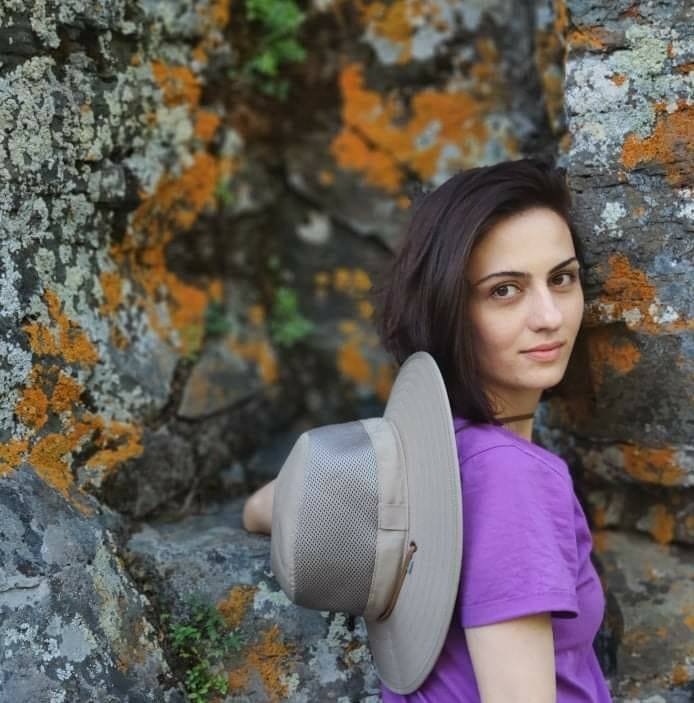
Ani Adamyan
The pedagogical path never truly ends; it continues as long as the teacher learns and educates, always ready to keep learning. My one-year journey in the Sebastatsi pedagogical environment has been a period of renewal, reinterpretation, experimentation, and inspiration at the same time.
At the start of the academic year, I went through a training phase that included the development, presentation, and discussion of pedagogical projects. This phase was important as an inner reassessment of the teacher’s role, methods, and approaches. We also had several trips during the training. I must highlight the overcoming of a summit, which was unique and symbolic for me-the highest peak in the Republic was conquered. It became a guiding reminder never to doubt about or hesitate in my abilities.
It was very important for me to feel from the beginning that in the Sebastatsi educational complex, a teacher is not only an instructor but also a creator of cultural environment, an opener of educational pathways, and a leader in project-based learning. Starting in 2024, I undertook the responsible and honorable mission of being a history teacher in the Mkhitar Sebastatsi Educational Complex. This marked a new stage in my pedagogical journey, filled with experience, creativity, and sincere dedication.
My main subject, history, is often perceived as a static collection of knowledge, but my pedagogical goal has been to present history as a living, interconnected, and inspiring process. That’s why the students who were previously indifferent during the year, began not only to love history but also to understand its significance and its connections to their presence and identity.
The role of the travel component in pedagogical activity
One of the key directions in my one-year pedagogical activity at the Sebastatsi EduComplex was undoubtedly the educational-travel component. The trips became not only an interesting part of the learning process but also an independent school-for both me and the students.
The preparation phase
Before each trip, we went through a preparatory phase that included both theoretical work and organizational readiness. Students studied in advance the historical and cultural features of the area we were going to: for example, information about Arates, the history of the Tezharuyk Monastic Complex, the village and mountain of Artanish, as well as various museum collections and educational programs.
This preparation ensured that the trip was not seen merely as entertainment but had an educational foundation. For me, this phase was also important because students learned to work with sources, gather information, compare, and discuss them as a group. They also learned the rules and etiquette of museums.
The Course of the Trip
During the trip, the students and the teacher become not only observers but also participants. In Arates, surrounded by nature, we managed to conquer the heights, which helped the students develop willpower and perseverance. In Tezharuyk, they not only observed the architectural features of the ancient monastery but also discussed the role of medieval Armenian church life. The camping experience in Artanish was even more engaging and entertaining. At camp, we become like a family—united, supportive, and ready to help one another.
During museum visits, I emphasize that students should not merely walk through the exhibition halls but also complete specific tasks—game-based challenges and small researches that later turn into discussions. The whole process was a school for me as well; I witnessed how the students gradually became more curious, began asking active questions, and tried to connect past events with the present.
The Result and Significance
After each trip, we hold a concluding discussion where the students share their impressions and the new knowledge they’ve gained, publishing stories and videos on their blogs. They often mentioned that while reading about history in the textbook made it seem distant and intangible, but during the trips it became vivid and tangible. I consider this the greatest achievement of my work, as interest in history is cultivated precisely through personal experience.
For me, the trips became a path of pedagogical self-discovery: I realized that learning organized outside the classroom is sometimes far more effective than textbook instruction. For the students, they are significant not only from the perspective of knowledge, but also for the development of social skills—they learned to work in groups, help each other, respect the environment, and appreciate their own cultural heritage.
Educational Camps
Alongside the trips, educational camps also hold a special place in our instructional process. Summer (June) and winter (January) camps are not only an opportunity for rest and recreation, but also an important educational platform. In the course of this year, we have implemented a number of projects. I will share the links below but I’ll highlight a few of them. The students really enjoy kitchen activities and excursions, and they also take part in museum educational programs with great enthusiasm.
In summer camps, students have the opportunity to enhance their knowledge through experiential learning in the open air, surrounded by nature. Through various games, teamwork, project-based activities, and creative exercises, they learn to collaborate, take responsibility, and show initiative.
Winter camps stand out with their unique atmosphere: the wonders of the winter season blend with learning, creating a festive yet knowledge-rich environment. These camps place greater emphasis on reading and art projects, as well as organizing discussions and master classes.
Camps, as well as trips, contribute to the comprehensive development of students:
- they acquire new skills,
- get to know each other better,
- learn to apply classroom knowledge in real-life situations.
As a result, camps become not only a space for education but also for spiritual growth, strengthening the bond between the school and its students.
About the Social Studies Review
During the academic year, the Social Studies Review also held an important place. March is the month of the Social Studies Review, within which students had the opportunity to present their knowledge and skills through project-based work. The review serves as a space for cooperation, exchange of experience, and creative initiatives. It became a unique platform for developing students’ critical thinking, encouraging teamwork, and organizing engaging and meaningful discussions on social studies topics.
Cultural Meetings
Within the framework of the Social Studies Review, we held several meetings. Our educational programs were enriched by the presence of two guests invited from the field of art. Particularly notable were the meetings with Arpine Saribekyan, art historian and director of the Gevorg Grigoryan Museum, and Lilit Hovhannisyan, director of the Nikolay Nikoghosyan Foundation. Each in their own way helped reveal the importance of creative thinking and artistic self-expression. The invited guests gave lectures on the influence of art on a person’s emotional and psychological world. These two meetings brought a new breath to our educational programs: students were inspired, and during the summer educational camp we made collaborative visits to the mentioned museums.
Psychology as the Core of Teaching
In my pedagogy, the psychological component serves as a key foundation. My academic background in psychology allows me to understand more deeply the student’s psychological characteristics, behavioral manifestations, motivation, and modes of communication.
When planning lessons, I have focused on:
- creating an atmosphere of emotional safety,
- ensuring an individual approach,
- fostering a culture of self-assessment and mutual understanding.
For me, the student has never been merely a “recipient of knowledge,” but an active participant in the educational process.
Educational Projects: A Process of Discovery and Creativity
Throughout the year, we carried out several projects aimed at both subject-specific and community-based, cognitive goals. Among them, I would highlight the “Discover Kond” project implemented with eighth-grade students.
The project was aimed at uncovering the history, cultural layers, and residents’ memories of Kond—one of the oldest neighborhoods in Yerevan. The students went out into the community, conducted interviews, filmed videos, studied old sources, and turned their work into a short historical film.
This was not only a cognitive project but also a valuable experience in planning and executing a project. It also contributed to the students’ rethinking of their attitudes towards their surroundings and the city itself.
Pedagogical Club
During the academic year, the Pedagogical Club, led by the much-loved Mariet Simonyan, played an important role. The club’s meetings gave novice teachers the opportunity to discover new methods and approaches in education. It became a platform for exchanging experiences, where key issues of modern pedagogy were discussed, and we concluded the year with final projects.
Through Mrs. Mariet’s initiative, the club contributed to professional growth and the creation of a creative atmosphere. We gathered not only to share experiences and ideas, but also to read and discuss articles by veteran teacher-psychologists. These meetings fostered our professional development, gave us the chance to reassess teaching styles and methods, and allowed each participant to share their own experience and perspective.
Thanks to the club, a creative and united environment was formed, where teachers constantly learned from one another. Deep gratitude to Mrs. Mariet for leading the Pedagogical Club and for facilitating the exchange of professional experience.
Difficulties and Prospects for Development
I have identified three important issues.
Despite the achievements, we encountered certain objective difficulties during the year. Lessons were often held in different classrooms without a permanent, quiet space, which at times hindered the process of focused teaching. Organizing classes under conditions of noise and environmental variability became a challenge. Nevertheless, it is the teacher’s duty to find flexible solutions and continue working effectively. For the next academic year, my expectation is to have a permanent classroom so that I can organize lessons as efficiently as possible.
In today’s world, the role of technology in education is irreplaceable. Learners, as representatives of the new generation, are sensitive to digital culture. They expect the teaching process to be engaging, modern, and delivered in diverse ways. To meet this demand, the teacher also needs a technically equipped learning environment. I am confident that ensuring a comfortable, stable, and technologically rich environment for the teacher is a priority for improving the quality of education. This is not only a guarantee of the teacher’s effectiveness but also of the student’s complete and fulfilling education.
One of the greatest and most complex challenges in teaching is working with students’ individual differences. The modern school is an open and inclusive educational system, where students with different abilities and diverse cultural and social experiences are welcomed. Naturally, this is an important and progressive aspect of education, but it places additional burdens on the teacher. Therefore, it is essential that the role of psychological support in the educational system not be considered an add-on or secondary service, but rather be viewed as an integral part of teaching. This will make it possible to create an inclusive, supportive, and growth-oriented educational environment—for the benefit of both the student and the teacher.
I will try to summarize this small but important article for me, as it is the first one. I consider the students’ feedback to be the most important achievement of my one-year work at the Sebastatsi Educational Complex. They often said that they had begun to look forward to history lessons, that they found them interesting, that they were thinking, analyzing, and starting to view historical events not as a detached past, but as a reality with meaning and substance. This success brought me joy, but at the same time created a new obligation—to continue developing the teaching of history.
The translation from Armenian into English by Lilit Melkonyan
Հայերենից անգլերեն է թարգմանել Լիլիթ Մելքոնյանը