
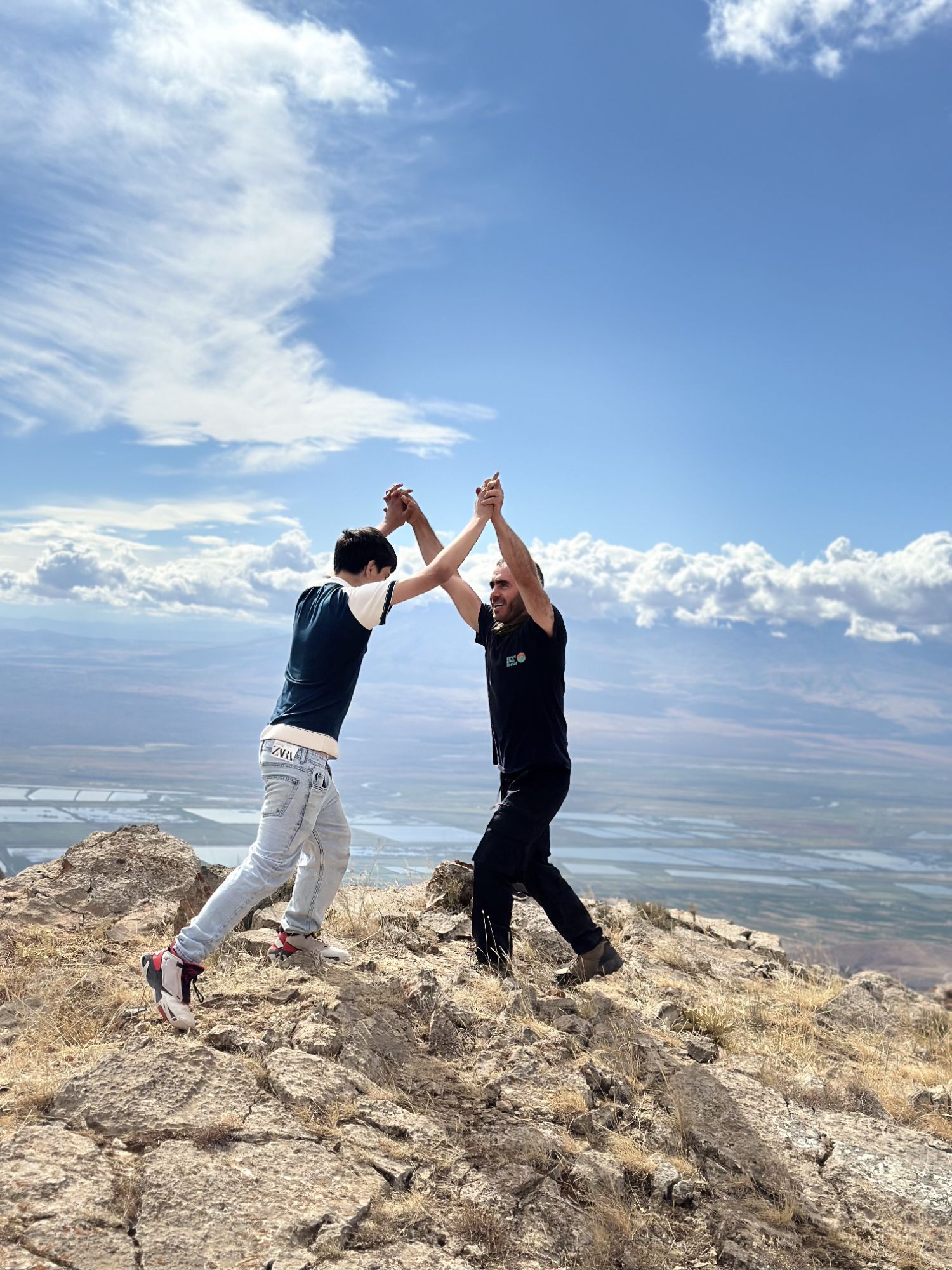
At the Mkhitar Sebastatsi EduComplex, the day beginning from 9:00 to 9:15 with national dances is no longer a simple morning warm-up. It has turned into a way of life, a return to identity, and a strong expression of community spirit. After two months of regular practice, the morning dance sessions have become something students look forward to every day. They have naturally grown into a cultural tradition that keeps expanding.
At the initial stage, the morning dances were simple national dances with an easy rhythm—first “Tamzara,” then “Aparan Gyovnd.” Each session included a short explanation of the movements, hand positions, and the logic of the circle formation, and then the full dance was performed.
The morning sessions became a special collective experience for us, where every movement and sound acted as a form of communication. Those 15 minutes started to change not only the students’ mornings, but also the whole educational environment, and the sessions even extended to 35–40 minutes.
First results and progress
The first two weeks were a period of active learning: students were still trying to learn the steps, feel the rhythm, and understand the structure of the dance. However, by the end of the second week, noticeable changes had begun to appear.
- Spontaneous student participation. Before the official start at 9:00, students began gathering on their own at around 8:40 and dancing without any instruction. Dance became an inner need instead of an obligation. As a result, the length of the sessions naturally reached 35–40 minutes.
- Growing interest in dance. Even students who initially had no interest in dancing began to join. Their curiosity grew step by step—from watching, to trying the movements, asking questions, and even suggesting new dances.
- Vocal involvement (“Hey” calls). At first, the students simply repeated the instructor’s “Hey” shouts. Later, these calls became spontaneous. The “Hey” began to appear naturally during emotional, energetic moments of the dance, turning into a shared expression of unity.
- Internalizing the rhythm of “Tamzara.” During “Tamzara,” the students started emphasizing the rhythm with synchronized claps (clap-clap-pause). This collective rhythm created strong cohesion—everyone moved together, breathing and acting as one group.
- Unity of song and dance. In some dances, especially “Aparan Gyovnd” (with the song “Shushva Kev”) and “Msho Khr” (performed by Gohar Hovhannisyan), we intentionally lowered the volume of the music. Soon, the students began singing while dancing. The dance became a living ritual performed by the group itself.
During this period, before involving the entire school, we tried to learn the dance “Yarkhushta.” As far as some students arrived late because of transport, the instruction continued for several days (Teaching also takes place every day with individual instruction). Students who were not dancing at first later became motivated after watching their classmates. This showed once again that dance is not just something to learn—it must be lived with full emotional engagement.
In reality, the morning national dance sessions are not only a physical activity, but also a collective emotional experience. Students begin to perceive themselves not as separate individuals, but as participants in a common movement. This kind of awareness is developed not through words, but through the body, voice, and rhythm.
Psychological and cultural significance
Students learn to express themselves not only through movement, but also through their voices—through “Hey” calls, singing, and clapping. This creates a safe environment where they can show their true energy without fear. Dance becomes a space for self-expression, freedom, and mutual understanding.
Here we can also mention Carl Jung’s idea of the “collective unconsciousness”. Jung believed that every culture carries its own collective memories—archetypes—that influence people unconsciously. When we dance Armenian national dances, these movements revive not only our individual memory, but also the accumulated experience of our ancestors. The shared “Hey!” becomes not just a sound, but an awakening of this memory. This is especially important for students aged 15–17, who are in the process of forming their identity and often face insecurity or difficulty expressing themselves. Dance offers a safe environment where they can break these barriers—without words and without judgment. Synchronized movement, clapping, and the “Hey!” shout become symbols of unity.
Educational and social significance
The morning dance practice is no longer just part of physical education. It has become a powerful means for emotional and social self-regulation. Through dance, students learn teamwork, discipline, and mutual respect. They learn to react to each other’s movements, feel the shared rhythm, and organize themselves as a group.
Such mornings are an everyday celebration at the EduComplex.. For students, they have become an energetic start to the day, which not only lifts the mood but also fosters a sense of pride in one’s own identity and culture. When a student moves to the rhythm of Armenian dance, they simultaneously learn the language of their identity.
How we achieved these results
So, national dance in the educational environment is not just art; it is a form of communication, self-discovery, and survival of community identity. Morning exercises have turned into a living space where students learn to live in motion, together with their roots, friends, and culture. However, in this article, we want to show what kind of work has led us to this result.
The outcomes described above did not only depend on the way of carrying out morning exercises and the person they were conducted by; it also has its invisible sides:
- The new admission format. This year, the College organized admissions through workshop activities. These workshops helped students understand what personal qualities they need to show during their studies and what level of involvement is expected from them.
- The involvement of the College director and instructors. Students see their teachers and the director dancing with them. This personal example motivates them and creates an atmosphere of equality and shared participation.
- The lessons of Comrade Laert (Laert Grigoryan). His classes are extremely important. He teaches every step carefully and in detail. Thanks to this, the morning sessions bring together students from different departments, helping to create unity, friendship, and cultural awareness.
Translated into English by Lilit Melkonyan