
For me, education is not only the transfer of knowledge, but also the language of hope, the meaning of existence, and a promise of the future. When I look back on the path I’ve traveled, I see not only an educational project, but also the voice of my heart, with which I try to resist the slow fading of our villages.
Taking on the work of a mentor felt like going back to my childhood home. Well, I’m originally from Vayk… But this return was different-now with a new perspective, a new sense of responsibility. My excitement was great, because I understood that I was no longer simply representing myself, but an entire educational system, a philosophy, a hope.
Every time I step through the doors of the Gomk School, I feel the weight and seriousness of the gazes directed at me. After all, I am there representing the “Mkhitar Sebastatsi” educational complex. In Gomk, they await us not only as a school, but as a friend, as a thought.
At first, I had fears, doubts, a sense of anxiety, excitement… Everything was mixed together… How could I, in just a few days, convey something that is the result of years of work? Where should I even begin? And what if this project doesn’t interest them? A whirlwind of questions. But then I realized that this very uncertainty and vulnerability became my creative and intellectual drive. They forced me to constantly review my approaches-searching for new, more vital paths.
I became, quite literally, a bridge-one that must be reliable, strong, and resilient… Otherwise, what would be the point of all this? A bridge that cannot withstand will destroy not only itself, but also all those who believed in it and walked across it.
What does it mean to be a bridge between an educational complex and a village like Gomk-a village where every young family, at a certain time of the year, faces the dilemma: stay or leave for the city? Mentoring, for me, became not just a professional activity, but a struggle for the survival of rural communities, for rejuvenating villages, for breathing new life into them.
We began our work not with one-off joint lessons, but by introducing them to our approach to education, showing the application of our teaching methods and their impact… In fact, we offered an alternative to leaving the villages. This was already a moral, existential step-a promise that had to be fulfilled… To become a participant and witness in transformation, in the creation of a new reality.
The day we first entered Gomk School and turned off the bell, I saw how the students’ faces changed. At that moment, I understood that a small change in the environment can radically transform students’ attitudes toward education and the educational space. It was astonishing to see how the sounds of music drifting through the school corridors brought smiles, curious looks, and conveyed a spirit of active participation.
After every visit, those bright eyes, smiles, and curious looks remind me again and again why I am here. They compel me to return to the same places with new ideas, new projects.
This mentoring experience was a rebirth for me-a transition from being a “regular teacher” to becoming a transmitter of original pedagogy, a program coordinator, a leader of community change, a carrier of a mission. The diversity of these roles requires daily rethinking, constant reflection on my own actions and activities, and subtle steps in communication.
Every visit to Gomk, every interaction, becomes for me a small school in working within a rural context. I realized how important it is to revisit innovative approaches, adapting them to the local reality. This is an inside view-a very subtle and important perspective. It is a genuinely creative challenge that demands taking into account the limited local resources, the importance of traditions, and the unique characteristics of the community.
When you enter a rural school, you understand that here every step, word, and action is examined under a microscope. In small villages, the school is the heart of the community. And the changes you bring ripple outward spreading from the school to homes, to the entire community.
This is not just a professional relationship. When you work with a remote rural school, you inevitably become part of people’s lives with their joys and sorrows, hopes and disappointments. I was deeply moved to see how Gomk’s teachers welcomed us-not only as professionals but as expected guests and friends.
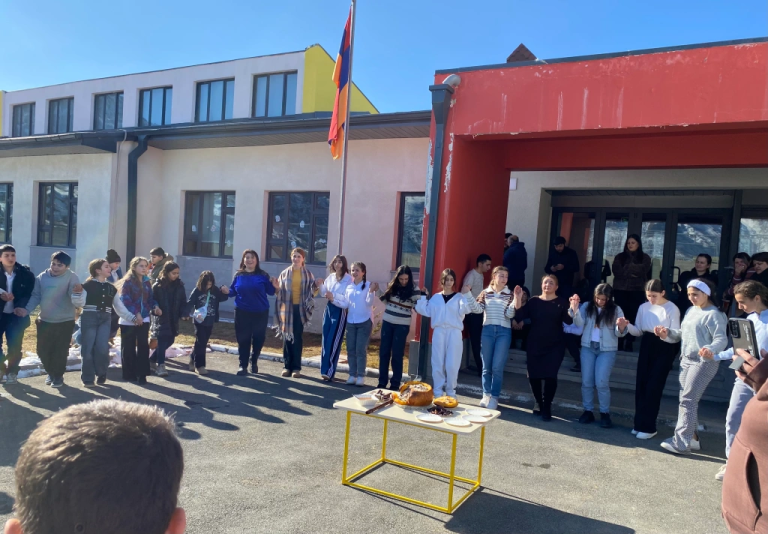
It was especially touching to walk around the village with the students and teachers, to celebrate in the old school grounds.
For the rural school teachers, mentoring became a way to overcome professional isolation. In villages, the school is a closed community where teachers can work for years without exposure to new methods or new pedagogical innovations.
I saw how, with each visit, something began to emerge within them what could be called pedagogical courage. At first, they were cautious: “Will this work in our school?” “Will we be able to do it?” “Are our children ready?” But gradually, those doubts were replaced by curiosity and an innovative spirit.
A special moment of pride for me was when, for the May flashmob, the “Mother Tongue” assignments were jointly developed by Gomk and Sebastatsi teachers. This meant that mentoring had already evolved into collaboration true exchange-where we learn as much as we teach, and where we share small victories.
For the students, our visits became a window into another world. What was especially touching was the hospitality of the educational complex’s students in rural homes. That hospitality became not just shelter, but a true learning experience. As I had written before, the goal was singular-to learn not only from books, but from people, the land, and real life.
I saw new horizons appear in the students’ eyes. In remote villages, the school becomes the only source of new possibilities. Our mentoring programs opened those horizons, showing alternative models of education and opportunities right within their own community-tangible and real.
When villages come alive
The hardest thing is helping people understand that living in a village doesn’t mean staying stuck in the past, being cut off from the world, or deprived of opportunities. Every time we work with Gomk School, we try to show that the rural environment can be an asset if education is tied to local reality, culture, and traditions.
I remember the ghapama ritual at Gomk Secondary School. No words can describe the feelings we all experienced. The pumpkin was from us, while the honey and dried fruits came from the nature of Vayots Dzor. This symbolic collaboration expressed the essence of our entire project-the fusion of tradition and innovation, and the mutual enrichment of city and village.
When education becomes the meaning of life
Today, looking back, I see that mentoring has changed not only Gomk School, but also me. It has become an inseparable part of my professional and personal life. As a mentor, my mission is to always see and make visible the true power of education.
When villages grow old, young people leave them, their gaze fixed on a future built in the city. I try to show that we can have a new type of rural school model-focused on the advantages and traditions of the village, while developing and modernizing it.
This experience proves that education can truly be a “real bridge” between different communities. It offers a valuable model for improving the quality of education in rural areas while preserving the richness of local culture and at the same time opening new horizons.
Every time I return to Gomk, I feel the responsibility to continue what we started. Because those bright eyes, those smiles, that trust remind me again and again, education isn’t about subjects and lessons, but a way of living, feeling, and creating.
For Sebastatsi students, visits to rural communities truly become a window into another world-a world where time flows at a different rhythm. Being hosted by rural households was a unique emotional and educational experience for the students of the educational complex. Staying in a village home is a way for Sebastatsi students to become direct participants in rural life, not just outside observers. They take part in the family’s daily routine and household life-cooking together, helping with chores, caring for animals, working in the garden. All of this creates a deep sense of shared experience, and this is the essence of genuine experiential learning, built upon personal experience and emotional connection. In this format, the impact is mutual-for both the Sebastatsi students and the villagers.
Time spent in the rural environment becomes a unique test of self-discovery. Away from urban comfort, technology, and familiar surroundings, students are compelled to meet their true “self.”
They discover their limitations and strengths, learn to adapt to new conditions, face difficulties, and appreciate simple joys. For many, this becomes an important stage of personal growth that changes their worldview. Once again, appropriate pedagogical work is carried out so that students can correctly perceive and approach the new environment awaiting them.
Host families gain the opportunity to share their lives and values, to feel the importance of their knowledge and experience. Students acquire reliable human connections that can be useful in life and, why not, in their professional activities. These connections become valuable social capital for both the students and the rural families.
Thus, hospitality in rural homes turns into a key component of the educational process, offering something no classroom can-an immediate sense of real life and deep human bonds. This is the true essence of education: to learn by living and to live by learning. These educational and human bridges in villages become sources of new perspectives. Our mentorship programs open up those perspectives, showcasing alternative models of education and opportunities within the community-tangible and real. It offers a valuable model for how to improve the quality of education in rural areas while preserving the richness of local culture and at the same time creating new opportunities. The bright eyes of the youth, their smiles, and the trust they convey remind us again and again-education is not about lessons, but about living, feeling, and creating.
We’ll meet again soon, with new stories to tell and a fresh wave of emotions.
The English translation is by Lilit Melkonyan