
Middle school is a stage of self-discovery for the learner. A great desire to know oneself emerges. Which academic subjects interest them most? Which school activities align most closely with their interests?
It is in the pursuit of these questions that learners, based on their own desires and range of preferences, have chosen educational projects that they have worked on with enthusiasm.
The educational project is a mandatory academic requirement defined by the 9th-grade curriculum of the Middle School.
Each learner at the Mkhitar Sebastatsi Educational Complex must complete at least one project during the academic year. In the 9th grade of Middle School, students carry out their educational projects based on their chosen elective activities, as an individual self-education project-or they carry out the educational projects and rituals determined by the academic calendar. Projects can be initiated by either the teacher or the learner.
I teach at the Middle School of the EduComplex, primarily the 9th graders. I have an elective group. We carry out various educational, and the students participate in them with enthusiasm.
During this academic year, the students in my elective group chose the project “Famous Armenians”.
Armenians have achieved such great success in the fields of science, technology, art, and sports in various countries that we can be proud of them, yet few of our students are familiar with them. Through the implementation of this educational project, students acquire information about world-renowned Armenians and are able to present it in English.
The goal of the project is to create an interesting educational package for schoolchildren, which will help them obtain information about famous Armenians in accessible English and be able to present it when necessary. The learners chose the famous people they were interested in, and together we compiled all the questions the answers to which would form the main part of the project content. The progress of the work was promising.
The process of collecting and processing materials turned into research work for the students. When conducting research work, learners can use various information sources. The quality criteria for the work include the completeness of data collection and the objectivity of the material presented, as well as the concise presentation of secondary details.
The learners’ project groups searched for and found content of interest to them in online sources and printed books. All materials were collected in a Word Office file, organized according to the content of the questions prepared in advance. It is also noteworthy that a group from the village of Lanjaghbyur in the Gegharkunik region participated in our project. They joined us accompanied by Linden Melmgren, a volunteer from the USA, and English teacher Aida Hakobyan. Our cooperation is not new.
Within the framework of the “Sebastatsi Days” festival, students and teachers from the Lanjaghbyur secondary school visited the EduComplex. They participated in the activities of the English language project group.
Lerrners from the EduComplex and the village of Lanjaghbyur also experienced joint camp days. The campers from the EduComplex were hosted in the homes of the villagers. In this way, they became closer to the natural and interesting daily life of the village. Together, they conducted environmental and ecological studies. They became acquainted with the region and the nearby historical and cultural sites that are significant to the locals.
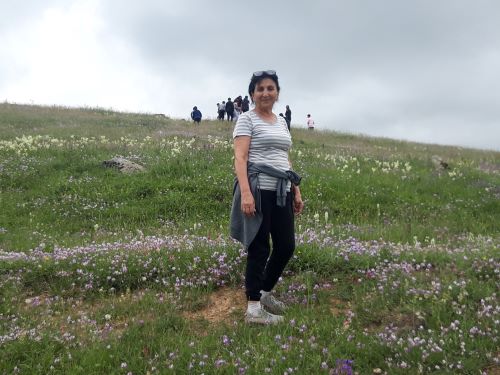
According to the Educomplex calendar, May 28 is the day for conquering heights for the Sebastatsis; Together with the groups from Lanjaghbyur, we conquered the height of Ilikavank.
The students of the first group presented their work.
I would also like to present the radio as an educational project. Educational radio is created as educational work and is the result of its implementation. It is supplementary education: an individual, group, family, or educational project for learners. This work is aimed at developing both written and oral speech. Choosing a topic, formulating questions, presenting them, engaging in conversation, thinking on one’s feet according to the situation, and posing new questions are important skills that a learner acquires while conducting interviews. “Saralanj” radio is an online radio project-a web radio-that has its own published schedule and a blog created and managed by the project coordinators. It has been broadcasting since November 2019. The radio’s debut was on the occasion of the educational complex’s festival. The goal of “Saralanj” radio is to:
- present and cover the events taking place at school;
- showcase the learners’ most interesting stories and interests.
Radio broadcasts are diverse, including literary, musical, and radio theater segments.
“Saralanj” radio is one of the most open and spontaneous media platforms at our educational complex. This is not just a series of recordings; it is a space where a student’s voice becomes audible and their thoughts become public. If you think that filming and recording radio broadcasts is easy work, then, unfortunately, you are mistaken. Imagine a school where everyone has the right to freedom; now, imagine how difficult it is to record a student amidst that noise and convince them to speak freely. Consider how challenging it is to edit all of that and, eventually, to write a script that needs to be revised nearly 100 times.
Despite this, students participate in the radio broadcasts with pleasure. I would like to quote the impressions of Maria Vatyan, a journalist for “Saralanj”:
“I am Maria, the voice of ‘Saralanj’ radio. I want to share my impressions and the work I have done. For me, being a radio host is not just a hobby, but the most important part of my school life. It also provides an opportunity to be at the center of school events and to be useful to my friends and teachers. I prepare for each broadcast with love, so that school breaks can be more joyful and informative. For me, the most memorable and responsible moment was the first broadcast. It was the beginning of the year, and there was a lot of excitement and curiosity. That broadcast was dedicated to news and the learners. Within the framework of that very first broadcast, I had the opportunity to interview Ms. Bush, the director of the Middle School. Our conversation centered on the expected news and plans for the new academic year, and I tried to do everything to make it impressive and unique. For me, this project is, first and foremost, an effectivework with Ms. Anahit Melkonyan. As the author and supervisor of the project, Ms. Anahit entrusted me with the honor of being the ‘voice’ of the radio. Her advice, support, and willingness to trust me helped me grow as a host and understand the nuances of this craft.”
Our meeting with the Public Radio and Television Commission had a meaningful follow-up. A few days later, we received an invitation from Public Radio, where our students were to participate in a scheduled broadcast to present the educational complex and their activities. We participated and received a subsequent invitation.
The guests of the “Zartutsich” (Alarm Clock) program on Public Radio’s “Arevik” children and youth radio station were students from the Mkhitar Sebastatsi EduComplex. They spoke about the educational complex’s busy daily life, educational projects, and other important realities that define the uniqueness of the educational complex.
Mane Ohanjanyan, one of the “Saralanj” radio journalists, continues to collaborate with the “Arevik” radio station; she is now one of Arevik’s journalists and has hosted dozens of broadcasts.
The V. Adamyan Secondary School in the village of Lanjaghbyur now has its own radio.
“Saralanj” is the learner’s voice, where freedom is combined with responsibility.
The English translation by Lilit Melkonyan